Beginner’s Watercolour Supplies Buying Guide
Some Art Supply Shops (London) & Online Stores(UK)
If you’re buying professional art supplies in London, these are the shops I personally use and recommend. (For store addresses and opening hours, it’s best to double-check via maps.)
Cass Art (multiple locations across London)
Easy to access with many branches. They run promotions from time to time (often in summer). For example, the Winsor & Newton Artists’ Water Colour 24-colour metal box can be a great deal when discounted.Jackson’s Art Supplies (London stores + online)
Great selection and very reliable for restocking. You can visit in person or order online.
https://www.jacksonsart.com/GreatArt (London store + online)
Convenient both in-store and online — a solid option for building a beginner kit.
https://www.greatart.co.uk/Cult Pens (online only)
I especially love their fountain pens and inks. They stock many international options that are harder to find elsewhere.
Watercolor paper
Before you buy watercolour paper, understanding these three concepts will help you find your paper
1) Cotton Content
Cotton content affects:
how smoothly colours blend
how fast the paper absorbs water (and dries)
how well pigment sits on the surface (and how clean your washes stay)
In general, 100% cotton paper is less likely to make your colours look muddy, and it tends to produce more consistent watercolour results.
My recommendation:
I strongly recommend 100% cotton paper
Try to avoid 0% cotton paper
If the packaging doesn’t mention cotton content at all, it’s usually safe to assume it’s 0%
If you’re on a budget:
Consider 50% cotton, or a more affordable 100% cotton option (prices vary a lot between brands and ranges)
2) Paper Weight (GSM)
The higher the GSM, the thicker the paper — and the better it handles water.
100gsm: very thin, warps easily
I don’t use it for proper paintings — only for testing colours and experiments. This is often the type of paper used for quick swatches in class.200gsm: suitable for small studies or travel sketching
A good option when you don’t need large wet-on-wet areas.300gsm: the most reliable all-round choice
Great for both practice and finished pieces — this is what I recommend most beginners start with.Above 300gsm: usually unnecessary for beginners and small paintings
Unless you need extra thickness (e.g., making cards).
Especially above 500gsm, the paper can become extremely thick and much more absorbent, which may “drink in” the pigment and make colours appear lighter. At this weight, paper is more commonly used by professional artists for larger pieces, or for other media — not necessarily for standard watercolour painting.
3) Texture
Watercolour paper typically comes in three textures: Hot Press, Cold Press, and Rough.
Hot Press: very smooth surface, minimal texture
Harder to get dry-brush texture, but excellent for fine details — e.g. anime-style work, portraits, facial features, etc.Cold Press: the most balanced and versatile option
This is my top recommendation and the one I buy most often. It supports detail while still giving you that classic watercolour texture, and with a bit of control you can achieve a wide range of brushmarks.
In my workshops, we use Arches Cold Press paper.Rough: strong texture, expressive marks
Great for landscapes and any painting where you want more texture and character in the brushwork.
Brand Recommendations (100% Cotton Watercolour Paper)
There are countless watercolour paper brands out there. This section is simply based on my personal experience with papers I’ve used, to help you narrow down your options.
If you ever find a paper you absolutely love, feel free to tell me in the comments — I’m always happy to collect real feedback and keep this list updated.
Quick tip: Full sheets are often the best value
In many professional art shops, there’s usually a large paper drawer/cabinet towards the back where you can buy full sheets of watercolour paper. Cutting them down at home is often the most cost-effective way to buy quality paper. You can ask:
“Do you sell full sheets of watercolour paper?”
“Where can I find full sheets / loose sheets?”
1) Best of the best
Arches
Saunders Waterford
2) Slightly more affordable (great value)
Fabriano Artistico
Khadi Papers
Khadi offers many ready-made sketchbooks, as well as pre-cut sheets in different sizes and shapes — a very convenient option.Canson – Moulin du Roy / Héritage
These are Canson’s 100% cotton watercolour paper ranges.
Stretching Watercolour Paper
If you plan to do large wet-on-wet washes, or you want your paper to stay flat while you paint, it’s worth learning how to stretch watercolour paper — this is the same step I demonstrate in my workshops.
What you’ll need
a firm board (often labelled as suitable for stretching watercolour paper)
gummed paper tape (water-activated paper tape)
watercolour paper
For tutorials, search: “stretching watercolor paper”.
Watercolor Paint
Watercolour Paint: Student Grade vs Artist Grade
Most watercolour brands offer two main ranges: Student Grade and Artist Grade (Professional Grade).
Artist Grade (Professional)
Typically, artist-grade paints offer:
higher pigment load and stronger colour
more reliable transparency and layering
smoother re-wetting and blending in many cases
relatively consistent appearance once dry (though this still varies by colour and brand)
Note: Artist grade doesn’t necessarily mean “natural mineral pigments only.” Pigments can be mineral, organic, or synthetic — the practical differences usually come down to pigment concentration, formulation quality, and consistency of performance.
Student Grade
Student-grade paints typically:
have a lower pigment concentration
may appear less transparent, depending on the colour
can look slightly duller or greyer once dry, especially when layered repeatedly
are more budget-friendly and perfectly fine for building skills
Quick tips (the key takeaway for beginners)
As a beginner, you may not notice a dramatic difference — the gap is often subtle, and it won’t determine whether your painting is “good.”
Artist grade is often around twice the price of student grade (varies by brand). Choose based on your budget and commitment.
A palette of paints can last a very long time. When you finish a frequently used colour, you can simply replace that single colour.
Tube Paint vs Pans: What should beginners buy?
For most hobby painters (especially if you’re not working very large), tubes and pans can produce similar results.
I generally don’t recommend tubes for beginners, because:
they come in larger quantities and are hard to finish
unused paint can dry out over time, which affects usability
they usually require more upfront spending
For beginners, pans (half pans / full pans) are often the most practical choice: easy to control, long-lasting, and budget-friendly.
How Many Colours Should Beginners Buy?
If you’re choosing between 12 / 24 / 48 colours, my recommendation is simple: start with a 24-colour set.
12 colours: often too limited for beginners
You may miss some beginner-friendly, easy-to-use colours, which means you’ll need to mix a lot from day one — mixing becomes unnecessarily difficult early on.24 colours: the most balanced option
It gives you a solid range to paint confidently, while still encouraging you to practise mixing rather than relying on ready-made shades.48 colours: usually not ideal at the beginner stage
Too many ready-made colours can make you over-rely on the palette, instead of learning colour mixing and relationships.
Note on “Student Grade” Naming
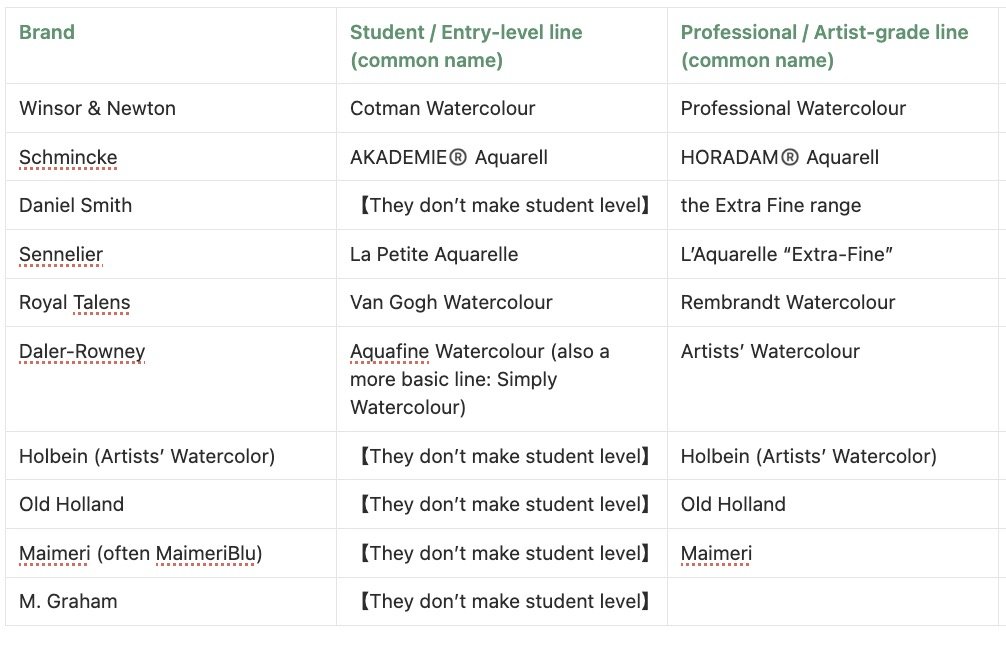
Some brands don’t label their paints as “Student Grade” directly. Instead, they use their own range names, which can be confusing. Here’s a quick name reference to help you identify what’s student grade vs artist grade.
Paint Brand Recommendations (based on my personal preference)
The brands above are all excellent and easy to find in London art stores. My suggestion is to simply pick one brand to start with — it doesn’t matter too much, because they’re all very, very good. If you’re still torn, here’s a very personal recommendation (for reference only).
Winsor & Newton (Artist grade)
Beautifully curated colour selection with very high transparency. Some people love how light and luminous it feels; others may find it a bit “pale” compared to more saturated brands.
I personally love it for landscapes, especially when I want an airy, transparent look.Schmincke
Very vibrant and saturated overall. Great if you enjoy painting everyday objects or prefer a more illustration-style look.
If your goal is natural, muted landscape tones, it may not be my first recommendation to start with.Daniel Smith
Rich, strong colours with a huge range of options. I love the intensity and variety — great if you want more depth and bold colour presence.Sennelier
A consistently strong choice — beautiful colours and a great overall painting experience.Mijello Mission Gold (often nicknamed “Hummingbird”)
Very clean, clear colours — the results tend to look crisp and fresh.Maimeri (MG)
Also an excellent paint, but it can have a slight smell. If you’re sensitive to scent, I recommend testing it first.
Brushes
Compared to paper and paint, brush choice is much more personal — it depends on your hand feel, painting habits, and style, so there isn’t one “correct” answer for everyone.
Many watercolour artists enjoy soft natural-hair brushes, especially squirrel hair, for a simple reason:
soft brushes hold a lot of water while picking up relatively less pigment, which makes them ideal for washes, gradients, and smooth blending.
Pointed round vs flat
Personally, I recommend starting with a pointed round brush, because it’s extremely versatile — you can paint both broad washes and fine details with one brush.
That said, many artists absolutely love flat / wash brushes, especially for efficient washes and edge control.
Budget tip (very important)
If your budget is limited, I recommend prioritising:
✅ paper + ✅ paint
Watercolour results depend heavily on the behaviour of water on paper — you don’t need lots of brushes to make progress.
The most practical beginner setup: three brushes or fewer
I personally paint with three brushes or fewer: one large, one medium, and one small.
In fact, about 90% of my paintings are done with a medium brush — the same one you used in my workshop.
These brushes are made in China with bamboo handles and squirrel hair, and I genuinely love this set. If you’re interested, you can find them here
https://venchoartstudio.com/shop/p/milk-dip-cup-92wf6-43lxy